Aimbot, ESP, Radar and Triggerbot: How the Main Gaming-Software Functions Differ
Understand the differences between Aimbot, ESP, Radar and Triggerbot, how they affect gameplay and which patterns can be noticed in a match.
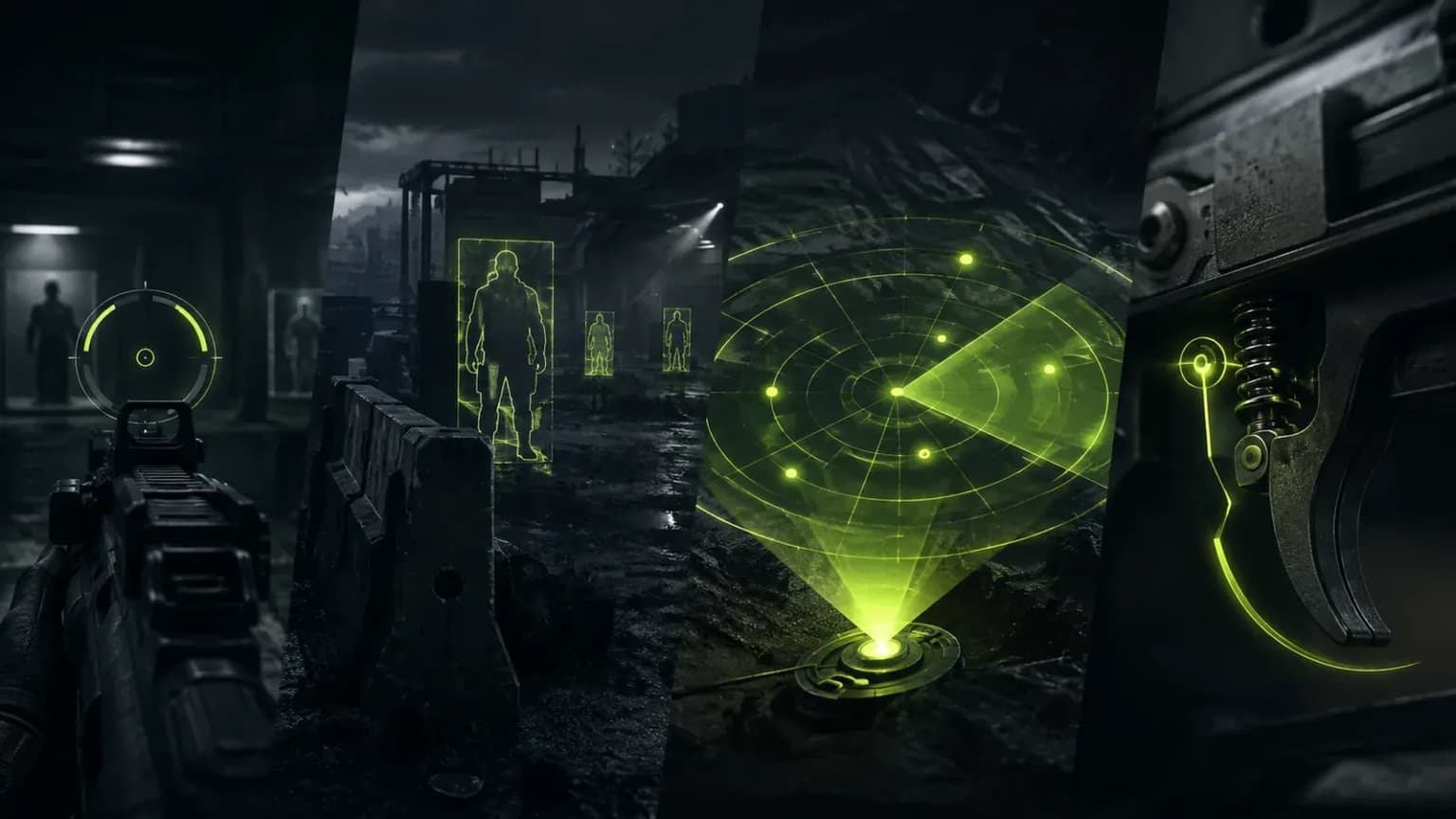
The terms Aimbot, ESP, Radar and Triggerbot appear regularly in discussions about online games. From the outside, they may seem to describe roughly the same thing every time: the player gains an advantage, so the distinction cannot matter very much. Yet the functions themselves work differently and affect gameplay in different ways.
In some cases, the intervention concerns the crosshair. In others, the player is simply shown more information than the standard interface provides. Sometimes only one action is automated, such as the exact moment of firing.
It is therefore not entirely accurate to group all these functions under one definition.
Contents
- Aimbot: when software assists with aiming
- ESP: extra information displayed in the game
- Radar: similar information presented on a map
- Triggerbot: an automatic shot at the right moment
- Why Aimbot and Triggerbot are often confused
- Which functions are harder to notice during a match?
- Why these functions have different names
Aimbot: when software assists with aiming
Aimbot is usually associated with shooting and crosshair position. The purpose of the function is for a program to take over part of the aiming process. How obvious this looks depends on the particular implementation. The crosshair may snap sharply towards a target, or it may move more smoothly and resemble a normal mouse correction.
Sharp movements are usually the first thing other players notice, especially when the crosshair switches from one target to another too quickly. Unusual aiming is not always so obvious, however. A skilled player can also react quickly, control recoil well and hit the intended point. One impressive moment therefore proves nothing. A repeated pattern is much more informative. Observers can then consider the overall shape of the gameplay: how similar the crosshair movements are, how often precise aiming occurs and whether ordinary errors are still present.
ESP: extra information displayed in the game
ESP serves a different purpose and may not affect the crosshair at all. It gives the player information about objects that the standard interface does not currently show. This can include the positions of characters, items or other elements of the game world.
Imagine a normal situation in which an opponent is behind a wall and the rules of the game provide no way to know their exact position yet. ESP can give the user that information early. The player still does the shooting: they move the mouse, choose the weapon and can miss or make ordinary mistakes. This is why such a function can sometimes be harder to identify visually. The suspicious element is not the shooting itself, but the player's decisions. They may, for example, look too often in precisely the direction from which an opponent appears several seconds later.
ESP commonly includes several ways of displaying data:
- markers for characters or objects;
- the distance to them;
- additional information about a target;
- highlighted items;
- various elements placed over the game image.
The exact set varies from one game to another. The general idea remains the same: information appears on the screen that an ordinary player would not be able to see at that moment.
Radar: similar information presented on a map
Radar is conceptually close to ESP, so the two terms are often mixed together. The difference is how the information is presented.
With ESP, prompts usually appear directly over the game image. With Radar, the data is transferred to a separate map, minimap or diagram. The player does not look through walls or see boxes drawn over characters; instead, object locations appear on a simplified plan of the area.
This changes the nature of the advantage. ESP is more convenient for understanding the position of an object directly ahead. Radar is better suited to assessing the wider situation: who is nearby, where movement may begin and which part of the map is currently occupied by opponents.
The function may be almost invisible to an observer. The player moves normally and shows no strange jumps of the crosshair, yet somehow remains prepared for events earlier than everyone else. This is what separates informational functions from those that intervene directly in shooting.
Triggerbot: an automatic shot at the right moment
Triggerbot does not handle aiming in the usual sense. The player moves the crosshair independently. The program waits until a target enters the required area and then performs an action automatically. Put simply, Aimbot helps move the crosshair onto a target, while Triggerbot reacts once the crosshair is already there.
The difference is small only in words; in the game, the resulting behaviour is different. With Aimbot, mouse movement tends to attract attention. With Triggerbot, the more relevant detail is the delay between the appearance of a target and the shot. Human reaction time always varies slightly. A person reacts faster in one situation and more slowly in another, depending on surprise, concentration, fatigue and chance.
An automated action may repeat with noticeably greater consistency. Even here, however, one incident is not enough to reach a conclusion. A person can genuinely press a button almost instantly. Suspicion arises when the same pattern is reproduced many times.
Why Aimbot and Triggerbot are often confused
Both functions are related to shooting, which explains the confusion, but they perform different parts of the task. Aimbot works with aiming, while Triggerbot controls the moment of activation. They can be used separately or included together in a single software product. The phrase “automatic aim” therefore does not explain which function is actually involved. The outcome also looks different to an observer: in one case crosshair movement is more noticeable, while in the other the crosshair may behave entirely normally.
Which functions are harder to notice during a match?
The most conspicuous example is a poorly configured Aimbot. When the crosshair snaps sharply between targets, even players who have never studied the technical side of cheats can notice it.
ESP and Radar are more difficult. They do not have to change the controls. A user can make mistakes, aim slowly and appear completely ordinary while still receiving information that would not normally be available.
Triggerbot is not always obvious at first glance either. In one short episode, a rapid shot can easily be mistaken for good reactions. Online games therefore rely not only on isolated incidents but also on statistics collected across dozens of matches. Repeated characteristics are much easier to recognise than a violation in one particular moment.
Why these functions have different names
Aimbot, ESP, Radar and Triggerbot are primarily names for individual capabilities, not necessarily four separate programs. One software product may combine several functions, while another contains only one.
Aimbot changes the aiming process. ESP adds information directly to the game image. Radar places similar data on a map or separate diagram. Triggerbot automates a reaction at a particular moment. These are more than differences in terminology. Each function changes player behaviour in its own way, which means the methods used to detect it differ too.
This is exactly why anti-cheat developers rarely search for a single universal indicator. Gaming software can interfere with different parts of the process, and these cases cannot all look the same.